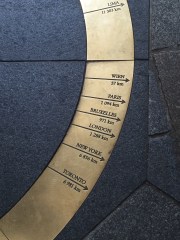
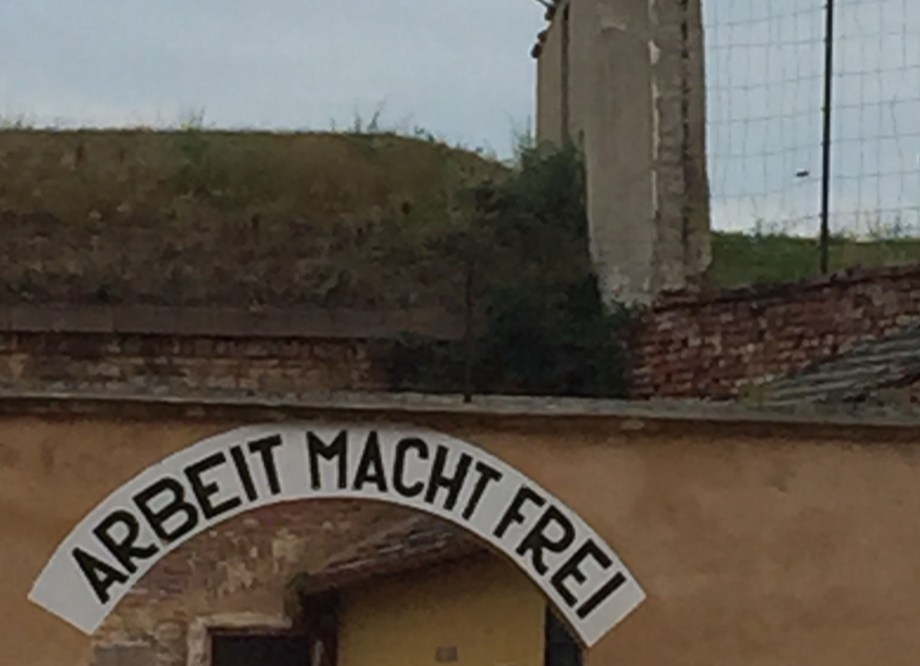
After almost a year away, we’ll return now to last summer’s travels, and in honor of the great Elie Wiesel* who passed away last Saturday, we shall pick up the thread at Terezin.
I will admit this was not my choice of excursion. I wanted to visit the Sedelec Ossuary instead, but my mother was intent to go and so we went, and in the end, I’m glad we did. It was certainly a much more somber day, but such days are sometimes necessary ones.
Thinking of visiting one of the camps, I kept remembering a scene from ‘The History Boys.” And thinking of writing about the experience now, it comes back to me again. Mr. Irwin suggests the class might discuss the Holocaust and Mr. Hector asks:
“But how can you teach the Holocaust? They go on school trips nowadays, don’t they? Auschwitz, Dachau. What has always concerned me is where do they eat their sandwiches? Drink their Coke? Do they take pictures of each other there? Are they smiling? Do they hold hands? Nothing is appropriate. Just as questions on an examination paper are inappropriate. How can the boys scribble down an answer however well put that doesn’t demean the suffering involved? And putting it well demeans it as much as putting it badly. What if you were to write that this was so far beyond one’s experience silence is the only proper response.”
But then Hector also says later:
Pass the parcel. That’s sometimes all you can do. Take it, feel it and pass it on. Not for me, not for you, but for someone, somewhere, one day. Pass it on boys. That’s the game I wanted you to learn. Pass it on.
And Mr. Wiesel himself spent his life working “to keep memory alive” and “to fight those who would forget. Because if we forget, we are guilty, we are accomplices.” So in the spirit of remembrance then, come take a walk with me through Terezin.

The fortress of Theresiendstadt was built as part of a larger fortification project by Austrian Emperor Joseph II between 1780 and 1790. The fortress itself and the walled town nearby were both named for Joseph’s mother, Maria Theresa. (I can’t help wondering what the good lady would have thought of that choice had she lived to hear of it.) The complex was used as a military fort through the 1800s, and then was repurposed as a political prison around the time of the First World War. The fort’s most famous prisoner was Gavrilo Princip, assassin of Archduke Franz Ferdinand (who, in case you were wondering, traces back to Leopold II, Joseph II’s brother).
The German army occupied Czechoslovakia on June 10th, 1940, and the Gestapo almost immediately took possession of Terezin, moving their first prisoners into the small fortress only four days later. The large fortress, or rather the adjoining walled town, wasn’t put into service until November 1941, at which point the Nazis began kicking out all of its non-Jewish residents. By spring of 1942, all 7,000 of Terezin’s occupants had been expelled, and the town was officially in use as a ghetto. In September 1942, at its most crowded, the town held 58,491 prisoners in buildings designed to house a mere 7,000 soldiers.
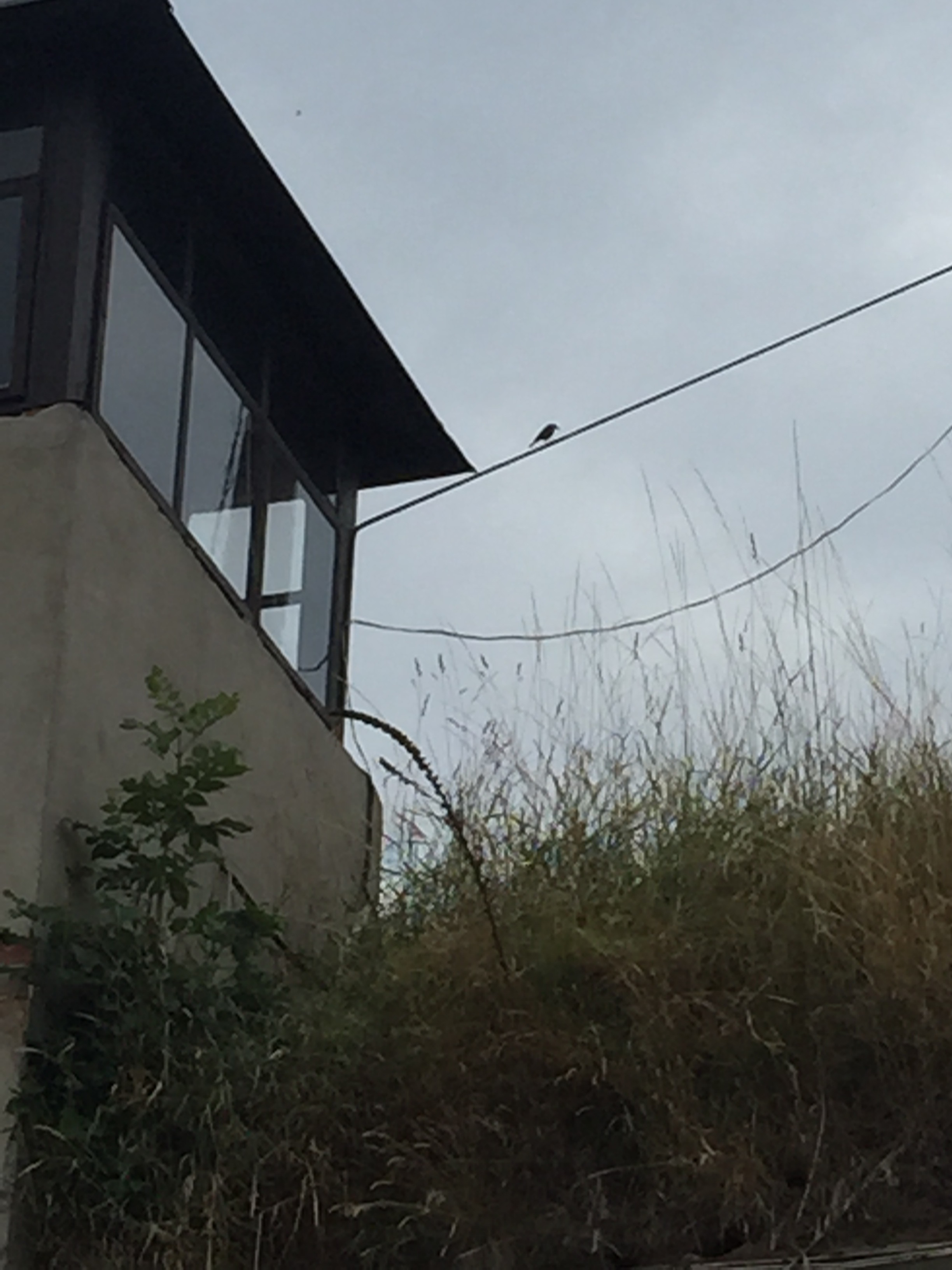
Although Terezin was never used as an extermination camp (the small fortress was intended for political prisoners and the walled town served as a transit camp for those on their way to the larger camps like Auschwitz), roughly 2,600 of the 32,000 prisoners in the small fort and 33,000 of the 144,000 Jews held in the larger ghetto fell victim to execution, starvation, or disease before the camps were disbanded in September of 1944. Surviving Terezin, however, did not mean you survived the war. In the month of liquidation (September to October 1944) 24,000 prisoners were moved to Auschwitz, many of these transports bearing the instructions of “special treatment.” The trains took them straight from Terezin to the gas chambers.


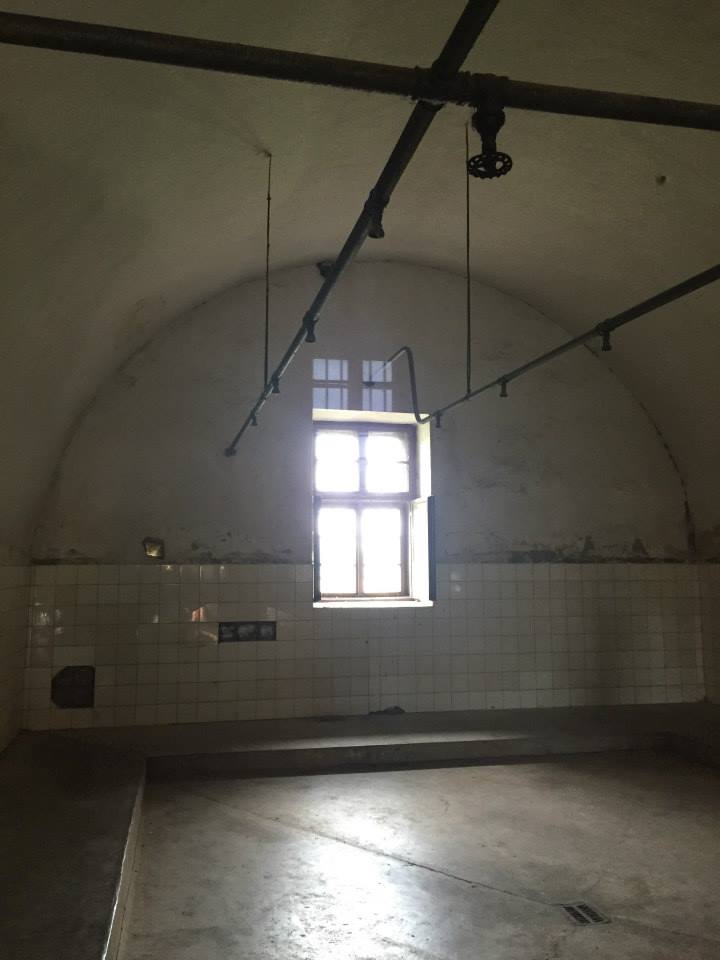
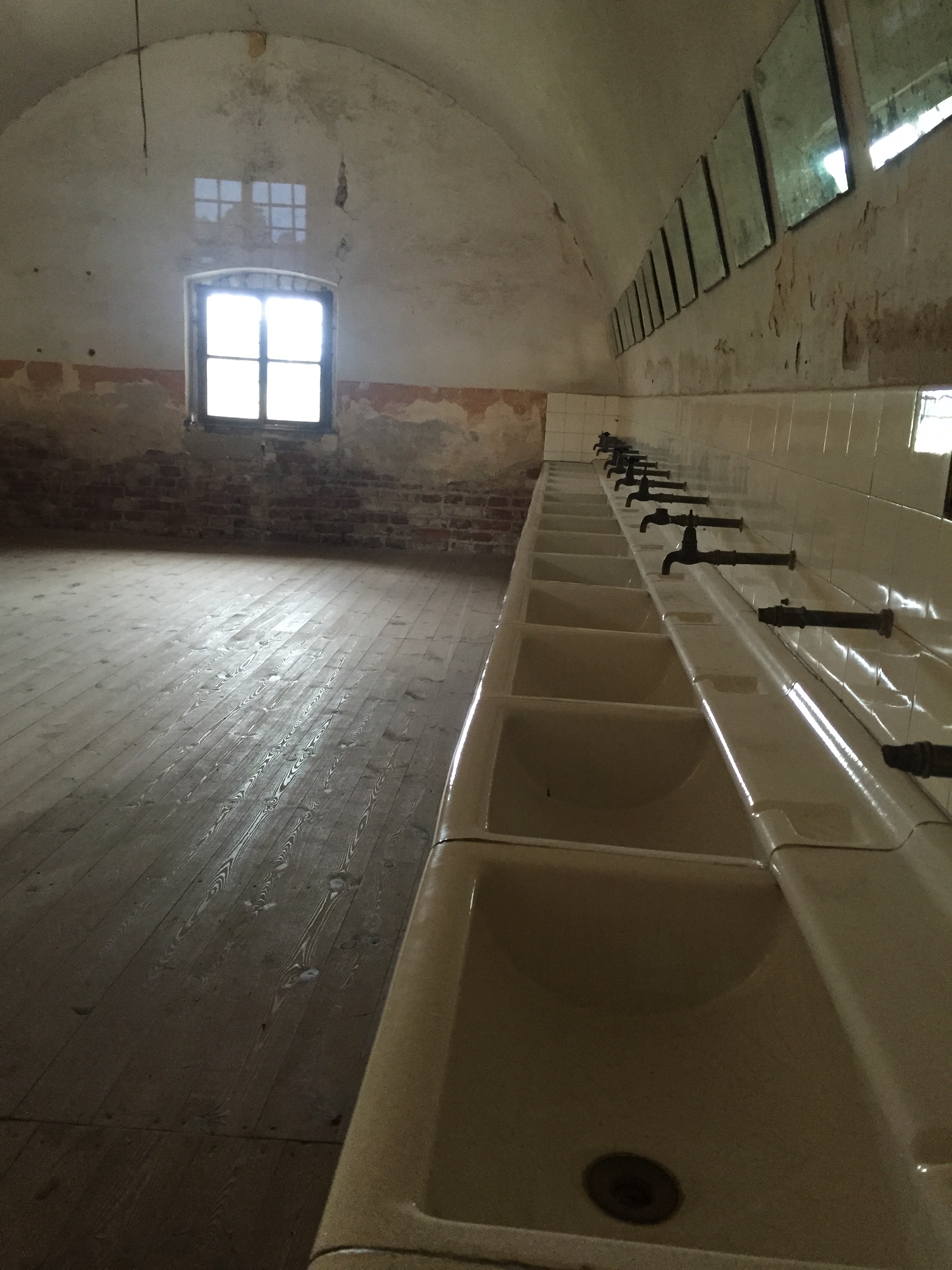
Despite the stark gravity of standing in the footprints of such horrific human cruelty, what struck me most about Terezin was how it was used in Nazi propaganda. Following the invasion of Normandy on D Day, 1944, the Nazis became intent on quashing the rumors that were rapidly spreading about the death camps. A delegation from the Danish Red Cross was permitted a visit to Terezin on June 23rd, 1944, and in the weeks leading to the visit, Terezin’s prisoners were put to work on ‘operation embellishment.” Transports chugged away, deporting many residents to Auschwitz to minimize the ‘appearance’ of overcrowding. Fake bathrooms were built along with fake shops and cafes in the ghetto, to give the impression of comfort and culture. When the construction was finished, the workers who had done the work were deported to Auschwitz for execution.

When the Red Cross delegation arrived, they were escorted through the facilities along a very controlled route. The prisoners they met had been pre briefed and instructed to answer only the questions of the German guards, not those of the Danish visitors. Apparently this charade satisfied, and the Red Cross delegation left with a positive report on the conditions at Terezin, so positive in fact, that the Nazis were inspired to milk a little more out of the ’embellishments.’ For 11 days, starting on September 1, 1944, Terezin and its prisoners served as the backdrop for a propaganda film entitled “Terezin: A Documentary Film of the Jewish Resettlement,” depicting the picturesque life ‘enjoyed’ by the Jews ‘resettled’ under the ‘protection’ of the Third Reich. As with the operation embellishment workers, the Jewish cast and crew used for the film were promptly deported to Auschwitz following the wrap. The film itself never got a chance to be released and a great deal of the footage has been lost or destroyed, but you can still watch parts of it at the Terezin museum today.

Terezin is a day trip from Prague, and though our excursion was all organized by Viking, it shouldn’t be difficult to find a tour to join for your own visit.
In his interview with Terry Gross in 1988 to which I listened before sitting down to write this morning, Elie Wiesel says that he believes “in words, in language, in communication,” but that “it is a strange world you are in when you deal with words,” “they grow, they get old, they die, they come back,” and sometimes they simply are not adequate.
And so I will leave you today with no more words, just these facts and photos, and a request to pass it on so that we honor those who lived it and so that we never let it happen again. Go see for yourself, listen to the stories of those who were there, and pass it on.

*RECOMMENDED READING: Night: Elie Wiesel
Just in case you never have, you should.
Elie Wiesel waited ten years after the liberation of the camps and then, on April 11, 1955, he sat down to write his story in “Night.” When asked why he chose to live his life as a witness to the Holocaust, Wiesel responded: “I believe that faced with the embellishment of a tragedy on one hand and the denial of a tragedy on the other, we who are still here must speak up as forcefully and gently as possible. We are leaving a legacy. We are bequeathing a certain message, a certain story,” so that when the last survivor is gone, those who wish to know will still know where to go to learn.
 I Digress