
This week I was planning to continue the thread of last summer’s travels with my favorite stop along the Danube, but then I finished reading an amazing book* about one of my favorite Boston characters, so I decided instead to take a small detour and introduce you all to Charles Sumner.
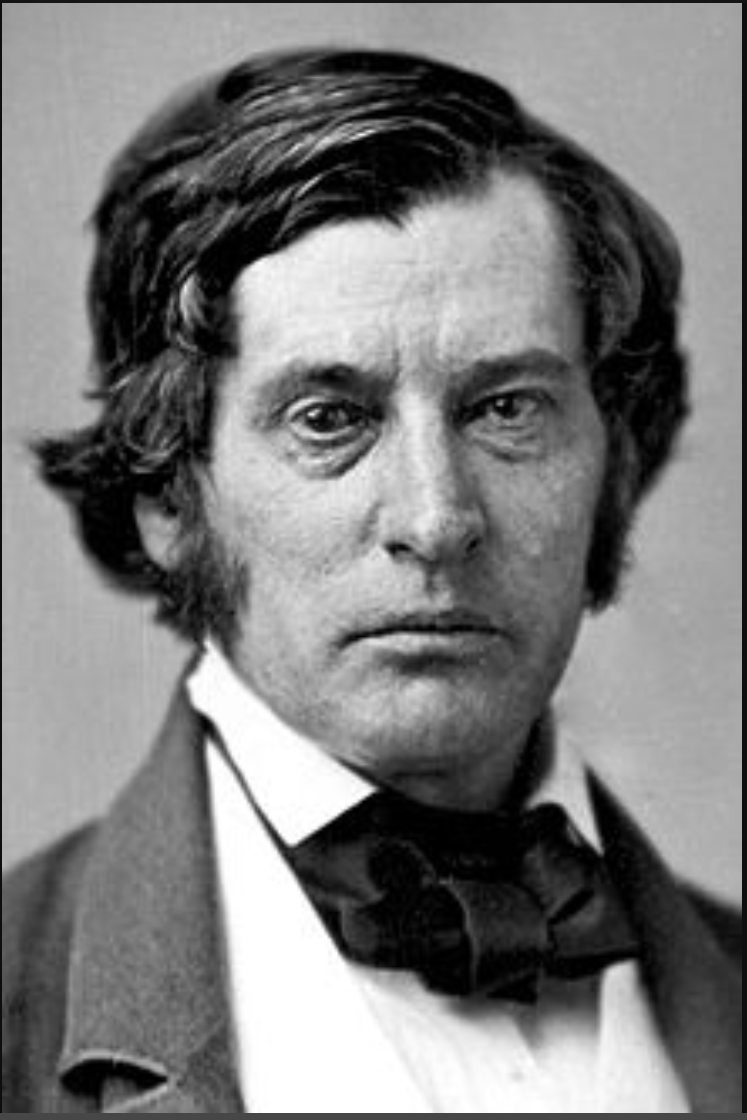
Few stories along my tour routes have captured my imagination quite as completely as Charles Sumner’s, and not being in Harvard as often as I once was, I just don’t get to tell his story enough.
Sumner went from being one of the most divisive to one of the most revered personalities in Boston and America thanks to a little incident in the US Senate in 1856. Thousands turned out to hear him speak, thousands to mourn his passing in 1874, and thousands more to escort his body to its final resting place, and yet today, very few people still know his name.
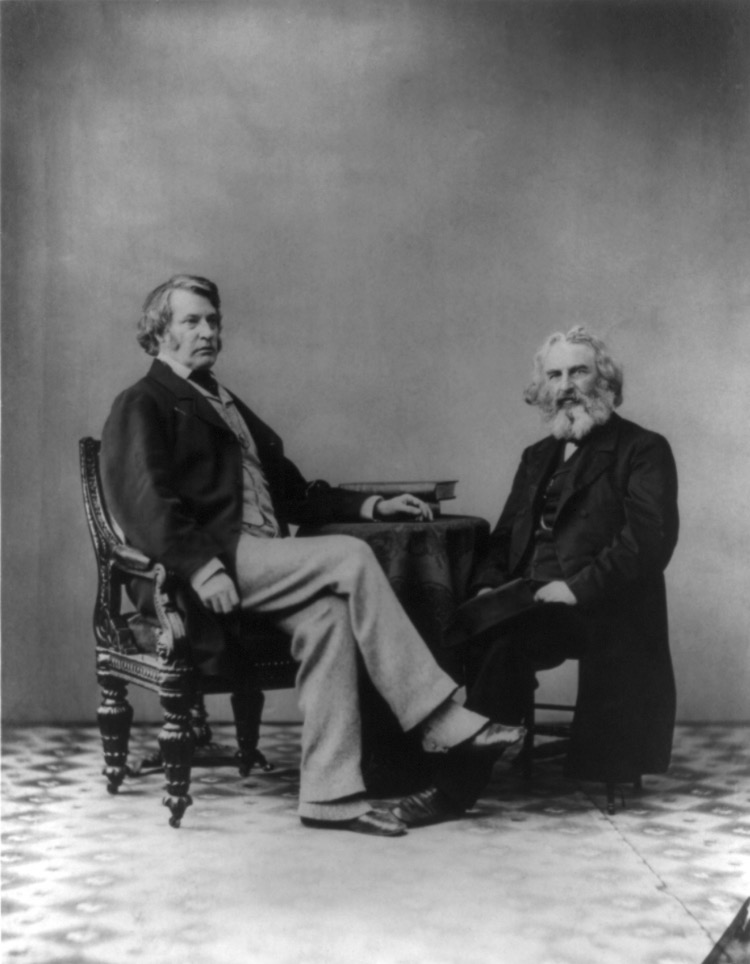
Sumner was born in Boston to a very demanding father, found his way through Harvard and Harvard Law, and then escaped to Europe where he would run headlong into the ideas which would define the course of the rest of his life. As a young man in the 1830s, Sumner had toured the South and seen slavery in action, but had been comparatively unmoved by the experience. When he got to Europe, however, he found himself in Paris, attending lectures at the Sorbonne, and was floored to be sitting in such a prestigious institution next to a black man. Sumner recalls being even more flabbergasted when this gentleman, and other black men in the class, proved themselves to be some of the most articulate and intelligent of those gathered that day. This incident shook Sumner’s American-bred perceptions of race, and as he continued his travels across the continent, he became even more convinced that we had it completely backwards here in the States. It was not biology, but society that was separating the races and that system had to change.
When Sumner returned to the U.S. he was an abolitionist. Not only that, but also one of the very first men to advocate complete equality between the races. Thanks to the controversies raised by the Mexican-American War and the Compromise of 1850, abrasive, outspoken Sumner found himself elected to the US senate in 1851, and took his campaign against the “Slave Power” to the national stage.
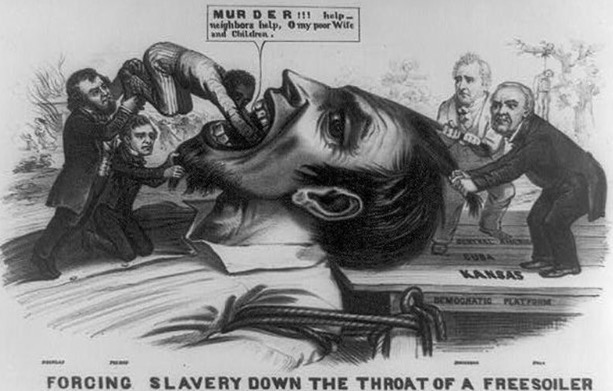 In 1854, another controversial act brought the tensions between the North and the South even closer to a head. The Kansas-Nebraska act overturned the Missouri Compromise of 1820 and encouraged ‘Popular Sovereignty” in new territories seeking to become states. Essentially, the Kansas and Nebraska territories were coming close to being eligible for statehood, and the free-state, slave-state balance was in jeopardy. Both territories clearly expressed free-state leanings, but the South would not give them up without a fight. Nebraska turned out to be too far north to be a good candidate for slave crops, and so the entire conflict moved to and settled in Kansas. The North was sending folks in droves to settle the territory, build hotels, churches and schools and to bolster the free-state vote when the time came for statehood. The South similarly sent folks in to sway the vote, though most of their representatives came from neighboring Missouri, not to settle permanently, but simply to exert enough influence to insure the Free Soilers did not prevail.
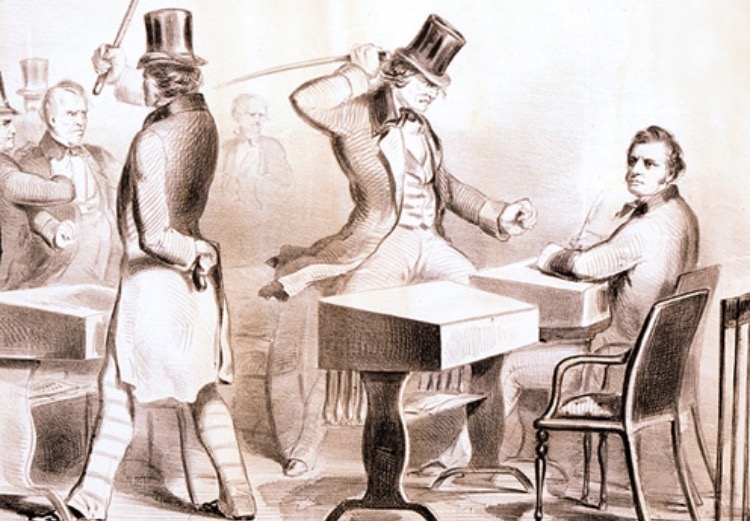
The outright violence that took over Kansas at this point inspired Sumner, on May 19th and 20th, 1856, to deliver one of his most famous speeches, “The Crime Against Kansas.” This scathing oratory spanned five hours over two days and seriously offended all of the Southern delegates, most especially one of the Congressmen from South Carolina, Preston Brooks.
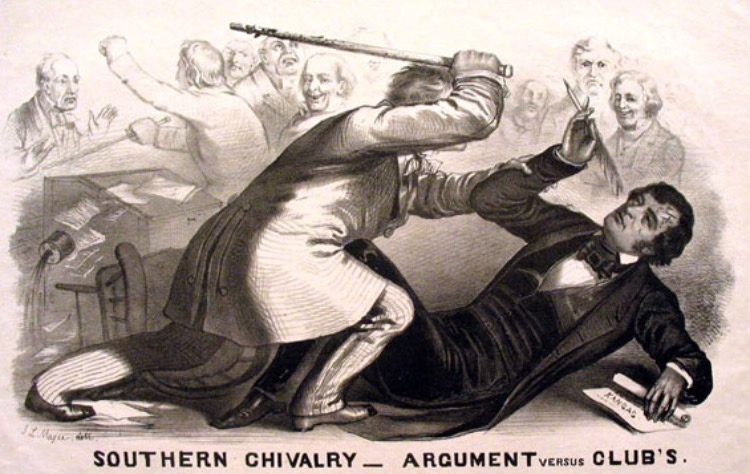
Two days after Sumner’s speech, on May 22, 1856, Brooks entered the Senate chamber and proceeded to beat Sumner thirty three blows with his gold-tipped cane. The beating lasted somewhere between 60 and 90 seconds until Brooks’ cane shattered, at which point he threw the remains down near Sumner’s prostrate body and left the Senate.

For this attack, Brooks was forced to resign his seat in the House. However, his fellow Southern delegates were so supportive of what he’d done that they made rings from the splintered wood of his cane to wear in solidarity. Back in South Carolina, Brooks’ constituents were similarly supportive and not only reelected him to Congress, but sent in droves gold-tipped canes to replace the one he broke.
In an odd twist of fate, Brooks would die of an esophageal infection less than one year after the Caning.
Charles Sumner lived.
It took him three and a half years to recover, and for that entire duration, Massachusetts chose to leave his seat in the Senate symbolically empty rather than elect a replacement. When he recovered, therefore, he regained his seat, and he served until his death in March, 1874.
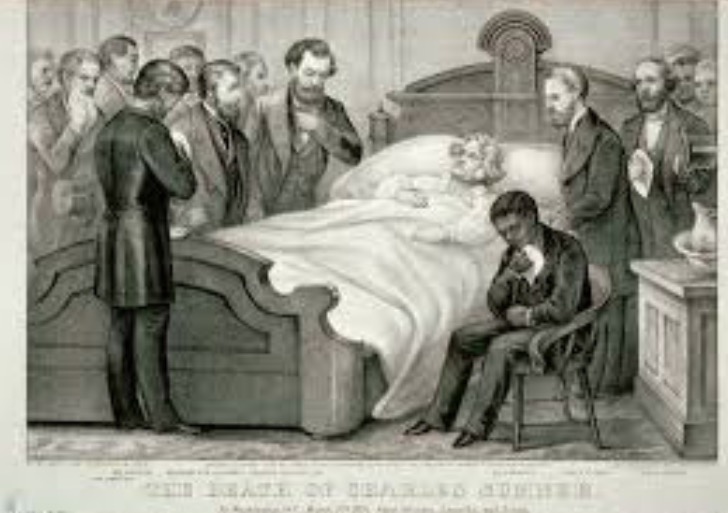
Sumner’s funeral was said to be a thing to behold here in Boston. His body was carried from the State House to King’s Chapel for services and then all the way across the river, past Harvard to Mount Auburn Cemetery to be interred. His mourners followed the casket on this five mile journey, and legend has it that when Sumner’s body entered Mount Auburn, the last mourners were just leaving King’s Chapel.
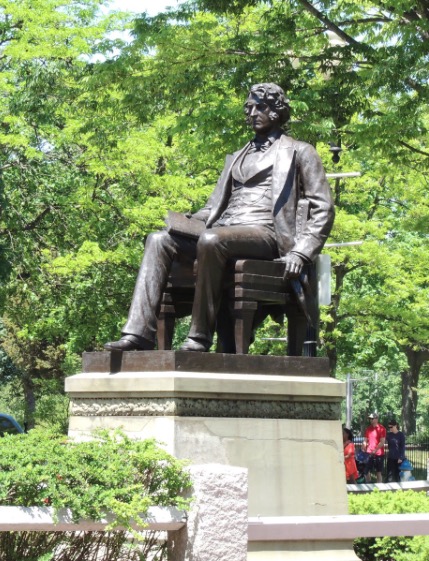
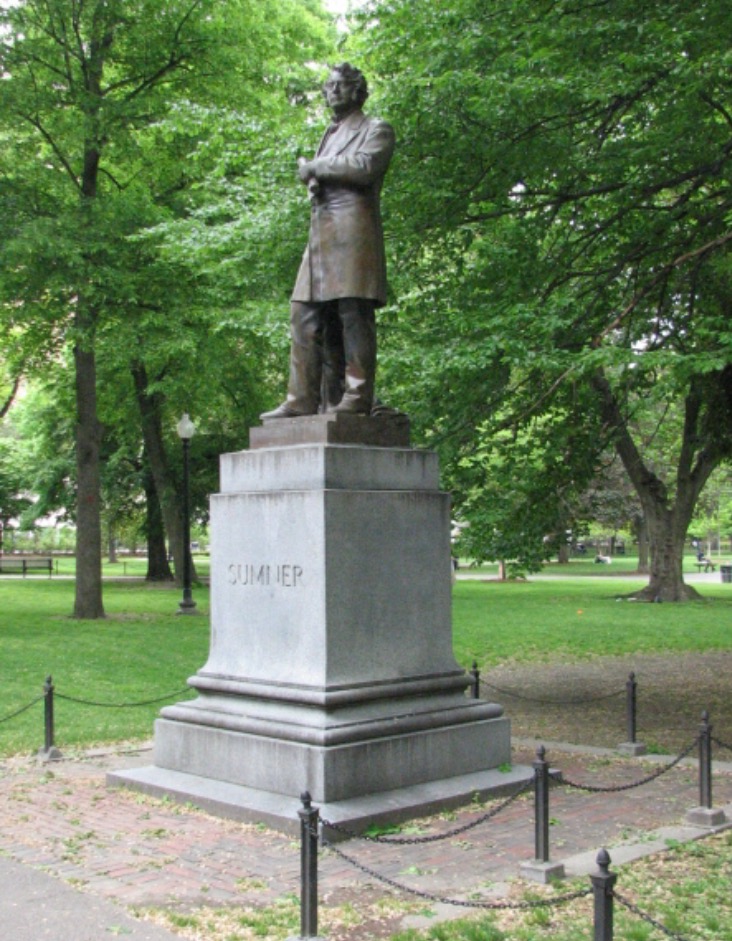
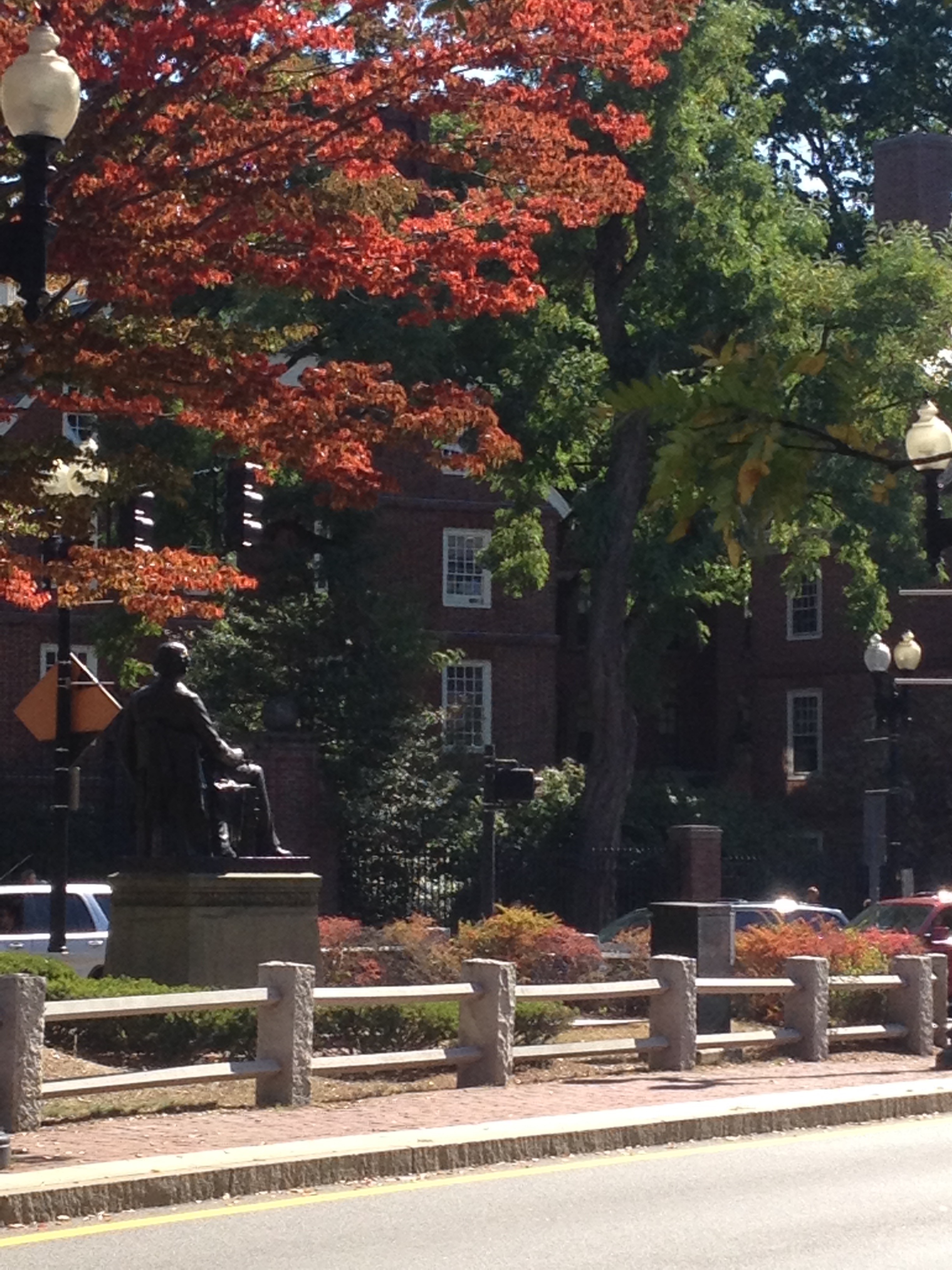
One year later, in 1875, Massachusetts decided to honor her great son by putting a statue of him in front of the State House in Boston. Now if you were paying attention at the start of this post, you probably noticed that I mentioned I usually talk about Sumner, not in Boston, but at Harvard. A blind contest was held to determine the artist who would create Sumner’s statue. All the hopefuls submitted their renderings without identification, and when the day came to select the winner, a woman stood up to claim the design. Her name was Anne Whitney, and the selection panel promptly told her that it would be “imprudent and improper for a woman to sculpt a man’s legs,” and therefore she was disqualified. They selected the runner up instead, whose statue of Sumner now stands in Boston’s Public Garden, near the State House. Anne Whitney waited 27 years and then finally decided to make her statue herself. The City of Cambridge found out about the project, raised enough money to buy it from her, and placed it in pride of place in front of the main gates of Harvard, where Sumner still sits proudly today, seen by more folks than walk past him in the Gardens.
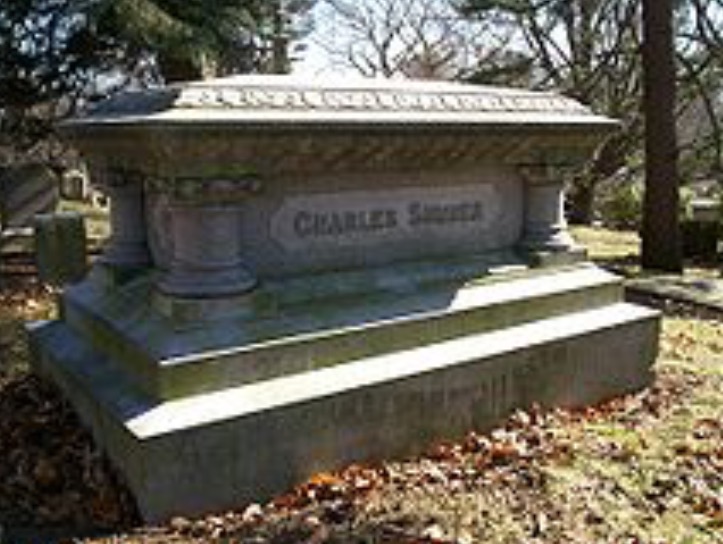
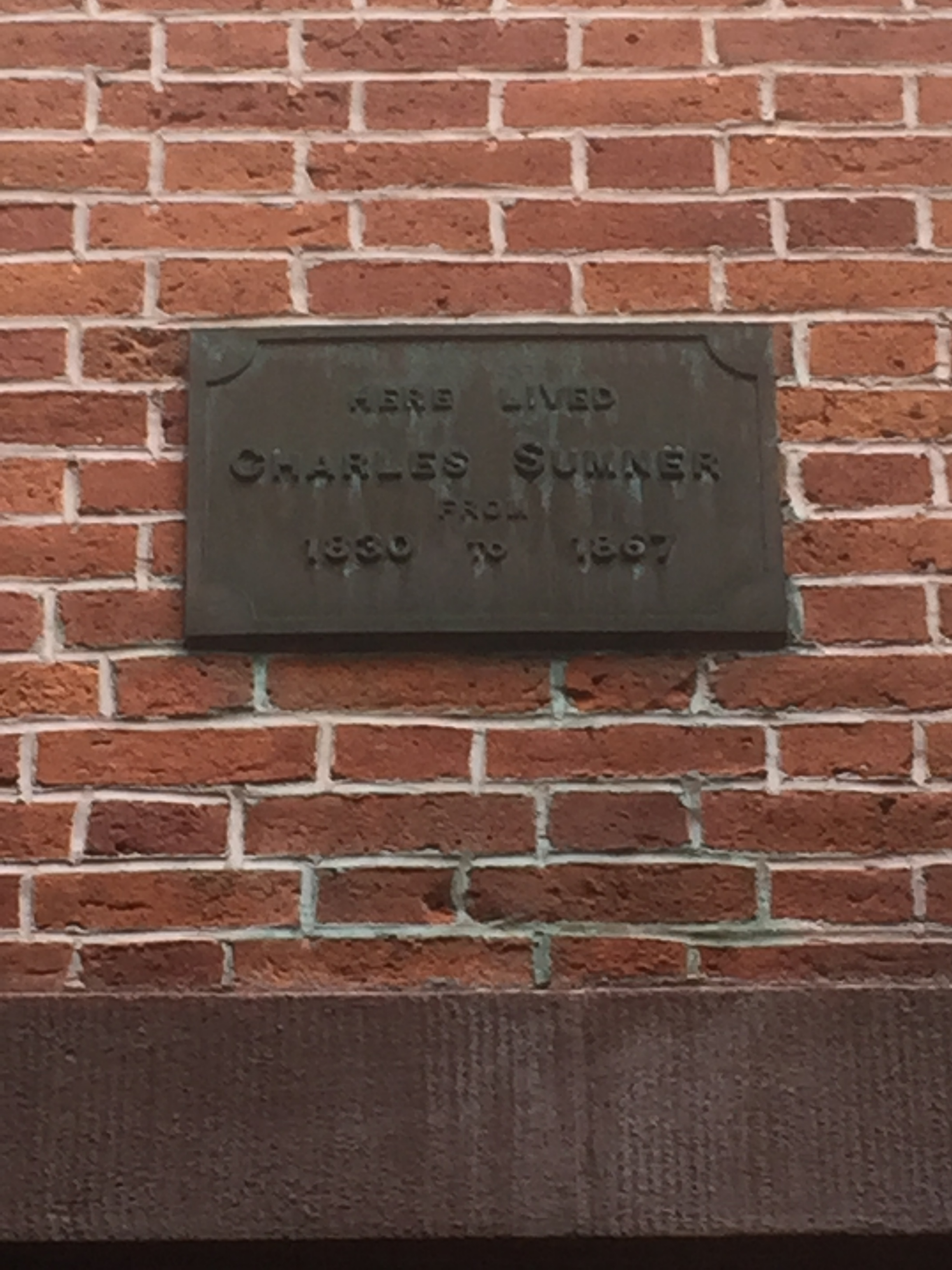
In his book, The Caning, Stephen Puleo points out that both of these statues, Sumner’s grave at Mount Auburn Cemetery, and the house where he lived on Hancock Street in Boston each carry only his name and perhaps a couple of relevant dates. At the time these monuments were erected, everyone knew Sumner, his story and his impact on American history. You didn’t need to add any fluff to those plaques. Today, even I who adore the man, had never been to visit his house until yesterday, and I did not know who he was until I came to Cambridge four years ago. I don’t know that I even appreciated, until I read Puleo’s book, how much of an impact Sumner actually had on the course of American history.
The more I learn about our past, the more I am able to connect the dots of what led to what, the more I dive into the lives of the individuals who were present during these seminal moments, the more I start to consider how much could have been different if people had only made different choices in their lives. What if Sumner had not defied his father and gone to Europe? What if Preston Brooks had overcome the baser urge to defend his family and state’s honor through violence? What if Sumner had given up the fight after the caning? What if our founding fathers had actually hashed out the slavery question while they were writing the Constitution? What if the cotton gin had not been invented in 1793? The fabric of our history looks so inevitable looking backwards, but half the fun of it is to dig right into the moments themselves and try to figure out how things looked through the eyes of those who were there. The human stories, after all, are what make the history. Maybe this one will inspire you like it has me, maybe not. Either way I like to tell it, and perhaps that is enough in the end.
Next week, I promise, back to the Danube!
 *RECOMMENDED READING: The Caning : Stephen Puleo
Puleo wrote one of my other favorite Boston books, A City So Grand: The Rise of an American Metropolis, Boston 1850-1900. He has also written a few other books on the area that are very well reviewed, but that I haven’t yet read. I should get on that. I cried reading the epilogue of this one. That’s some good writing. Check it out.
 I Digress