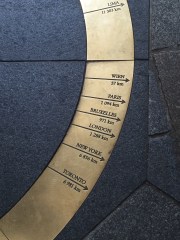

This is a post I wrote last August, one week after our trip to Virginia. I found it as I was sorting through my computer, looking for ideas for new posts, and I thought today might be an appropriate day to share it.
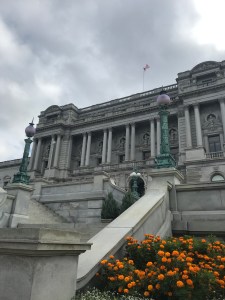
Last week Dylan and I traveled down to Virginia to attend the wedding of two of his grad school friends. At some point, it occurred to me that it had been almost two full decades since I was last in that part of the country, and so Dylan graciously offered to visit Monticello with me, and we decided to spend a couple of days in Washington D.C. seeing the sites. The wedding was lovely, Monticello was thrilling, and after three days in D.C., we found ourselves completely saturated with all we had seen along the National Mall. What we saw was a tiny fraction of The Library of Congress, an infinitesimal smidge of the National Archives collection, and a light sampling of The American History and Natural History Museums. We spent most of a day in the International Spy Museum as well, and even then, we only skimmed what was on offer. Oh, and of course, we visited the Lincoln Memorial.
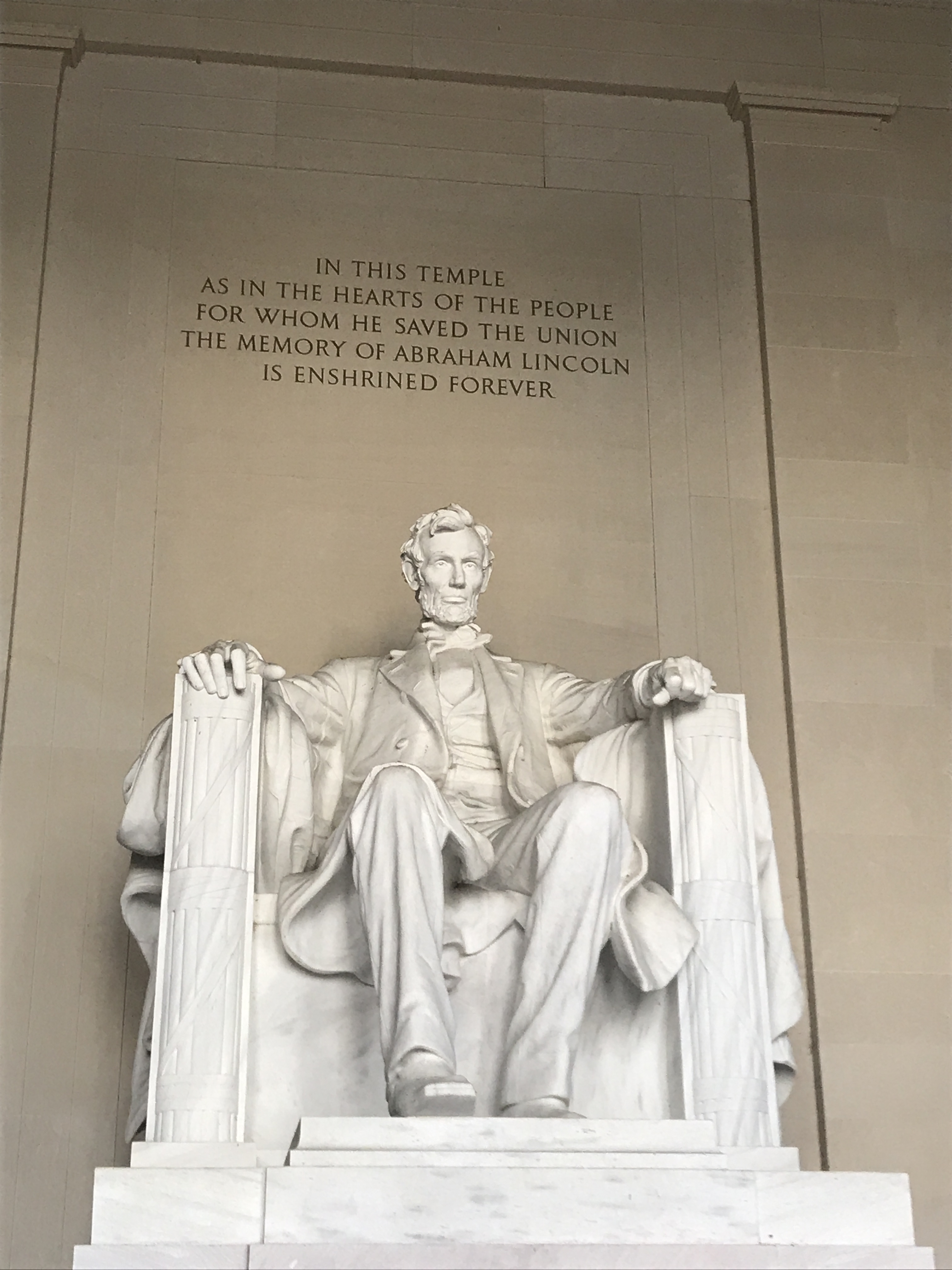
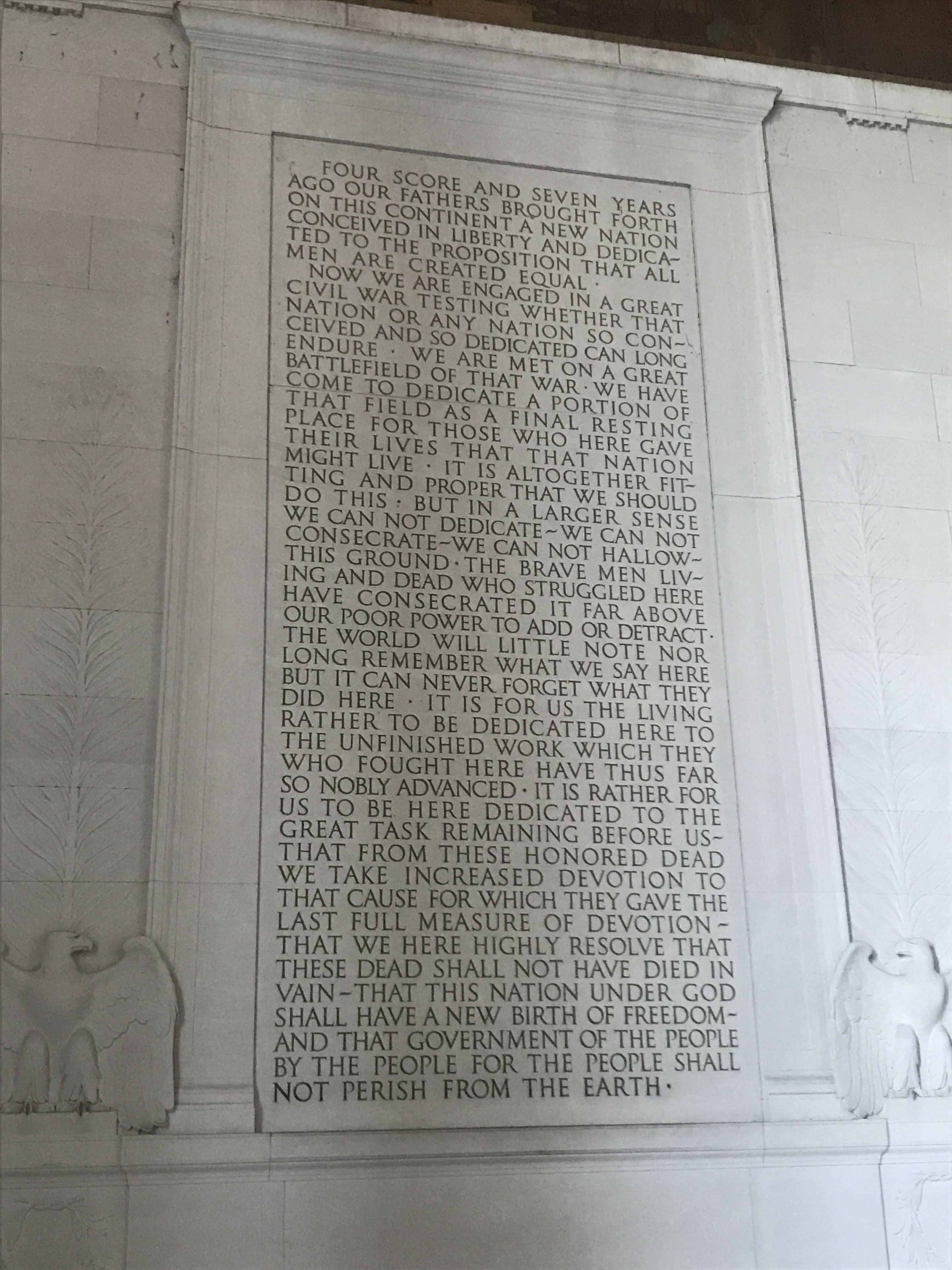
Now I mention the Lincoln Memorial on a fairly regular basis in my daily life, as its sculptor, Daniel Chester French, has a few notable works in the Boston area as well. And, of course, the image of that most famous of Daniel Chester French’s statues finds its way into so many movies, one almost feels inclined to skip the long walk down the mall to pay it a visit in person. But oh, all the images you’ve seen of it can’t quite compare to standing there in person, dwarfed by the towering figure of this mythic man and the text of his most well-remembered words etched into the walls beside him.
The day after our return to Boston, I was to give a tour of Mount Auburn Cemetery (one of my absolute favorite places) to a lovely woman who happened to have been a licensed battlefield guide at Gettysburg. Her list of graves she wanted especially to visit at Mount Auburn were mostly men who had fought or otherwise been involved in the American Civil War. Since my Civil War knowledge is slightly fuzzy, I read Thomas H. O’Connor’s Civil War Boston in preparation before we left on our trip.
And so, although we didn’t have any other Civil War stops on the docket for this particular adventure, I had the topic in mind when we went to visit Lincoln. Perhaps it was simply because I am a few years older than I was the last time I took a dive into the history of the American Civil War, or perhaps because I was examining it this time through the lens of Boston, which is very dear and familiar to me, but I found myself struggling forcefully this time around with the terrible question of Why?
Why did we spend four years sending countless young men out to slaughter each other on strangers’ farms? To ‘preserve the Union’? Why? If we had spent 85 years arguing with each other over the issue of slavery, why not just agree to part ways, arranging to split the remainder of the continent along the 36 30’ parallel? If the South wanted so badly to leave, why not just let them? Certainly, there were serious financial ramifications to consider, and issues of pride. But might it not have been simpler to hammer out those business deals between nations at a negotiating table rather than suffer through the horrors of war and reconstruction? Having grown up in the South, I wanted for many years to find more complicated reasons for the Civil War than slavery. I wanted to think it had more to do with preserving a culture, a way of life, for both sides. I still have no doubt that that was probably the prevailing reason for many of the individuals involved. But ultimately, it can only have been that horrible question of human bondage that drove the wedge and kept the two sides slogging on for almost half a decade. That and some lingering vision of what this fledgling country could be if we could only stick it out long enough to try.
When I look at the horrors of the Second World War, I am floored, but I can see the very clear implications of Churchill and FDR not rallying the Allied forces forward. If any wars are necessary, that one certainly must have been because the wheels were already in motion towards a much darker future. Was the American Civil War necessary?
Inevitably, perhaps, Lincoln said it best at his second inaugural address on March 4th, 1865:
On the occasion corresponding to this four years ago, all thoughts were anxiously directed to an impending civil war. All dreaded it– all sought to avert it. While the inaugural address was being delivered from this place, devoted altogether to saving the Union without war, insurgent agents were in the city seeking to destroy it without war– seeking to dissolve the Union, and divide effects, by negotiation. Both parties deprecated war; but one of them would make war rather than let the nation survive; and the other would accept war rather than let it perish. And the war came.One-eighth of the whole population were colored slaves, not distributed generally over the Union, but localized in the Southern part of it. These slaves constituted a peculiar and powerful interest. All knew that this interest was, somehow, the cause of the war. To strengthen, perpetuate, and extend this interest was the object for which the insurgents would rend the Union, even by war; while the government claimed no right to do more than to restrict the territorial enlargement of it.Neither party expected for the war the magnitude or the duration which it has already attained. Neither anticipated that the cause of the conflict might cease with, or even before, the conflict itself should cease. Each looked for an easier triumph, and a result less fundamental and astounding. Both read the same Bible, and pray to the same God; and each invokes his aid against the other.It may seem strange that any men should dare to ask a just God’s assistance in wringing their bread from the sweat of other men’s faces; but let us judge not, that we be not judged. The prayers of both could not be answered–that of neither has been answered fully.…If we shall suppose that American slavery is one of those offenses which, in the providence of God, must needs come, but which, having continued through his appointed time, he now wills to remove, and that he gives to both North and South this terrible war, as the woe due to those by whom the offense came, shall we discern therein any departure from those divine attributes which the believers in a living God always ascribe to him? Fondly do we hope–fervently do we pray–that this mighty scourge of war may speedily pass away. Yet, if God wills that it continue until all the wealth piled by the bondsman’s two hundred and fifty years of unrequited toil shall be sunk, and until every drop of blood drawn by the lash shall be paid by another drawn with the sword, as was said three thousand years ago, so still it must be said, “The judgments of the Lord are true and righteous altogether.”With malice toward none; with charity for all; with firmness in the right, as God gives us to see the right, let us strive on to finish the work we are in; to bind up the nation’s wounds; to care for him who shall have borne the battle, and for his widow, and his orphan–to do all which may achieve and cherish a just and lasting peace among ourselves, and with all nations.
All these thoughts struck me most forcibly as we stood near the great statue of Lincoln and read those words on the wall beside him. And then, when we turned to walk down the steps of the memorial, I saw coming up them a group of women wearing those dreadful red MAGA hats, and I felt like I might cry.

One of the most beautiful things about this great experiment that we call the United States of America, is that we all have the absolute right to express our beliefs and opinions, our wants and our fears. But to me, those wretched hats symbolize nothing but violence and hatred. Again, I have no doubt most of this stems from some very justifiable fears about how the world is changing, and how we must change in it. As a person who wrestles with anxiety, I completely understand how terrifying change can be, and I certainly cannot begin to claim to have solid answers to any of the truly enormous problems facing our country and our planet today. But that cannot be an excuse to so violently threaten the safety of our neighbors. Curtailing the freedom and threatening the safety of others does not make any of us safer, it only breeds more fear, more hatred, and more violence. Wrestle as I might, I cannot fathom how anyone can walk down that National Mall, absorb even the smallest fraction of all the truly amazing FREE resources lined up and waiting there, stand in front of that statue, reading those words, and continue to think that walls and guns and subjugation are the answer to anything. How much more blood, how many more lives will it take for us to learn that we are all the same?
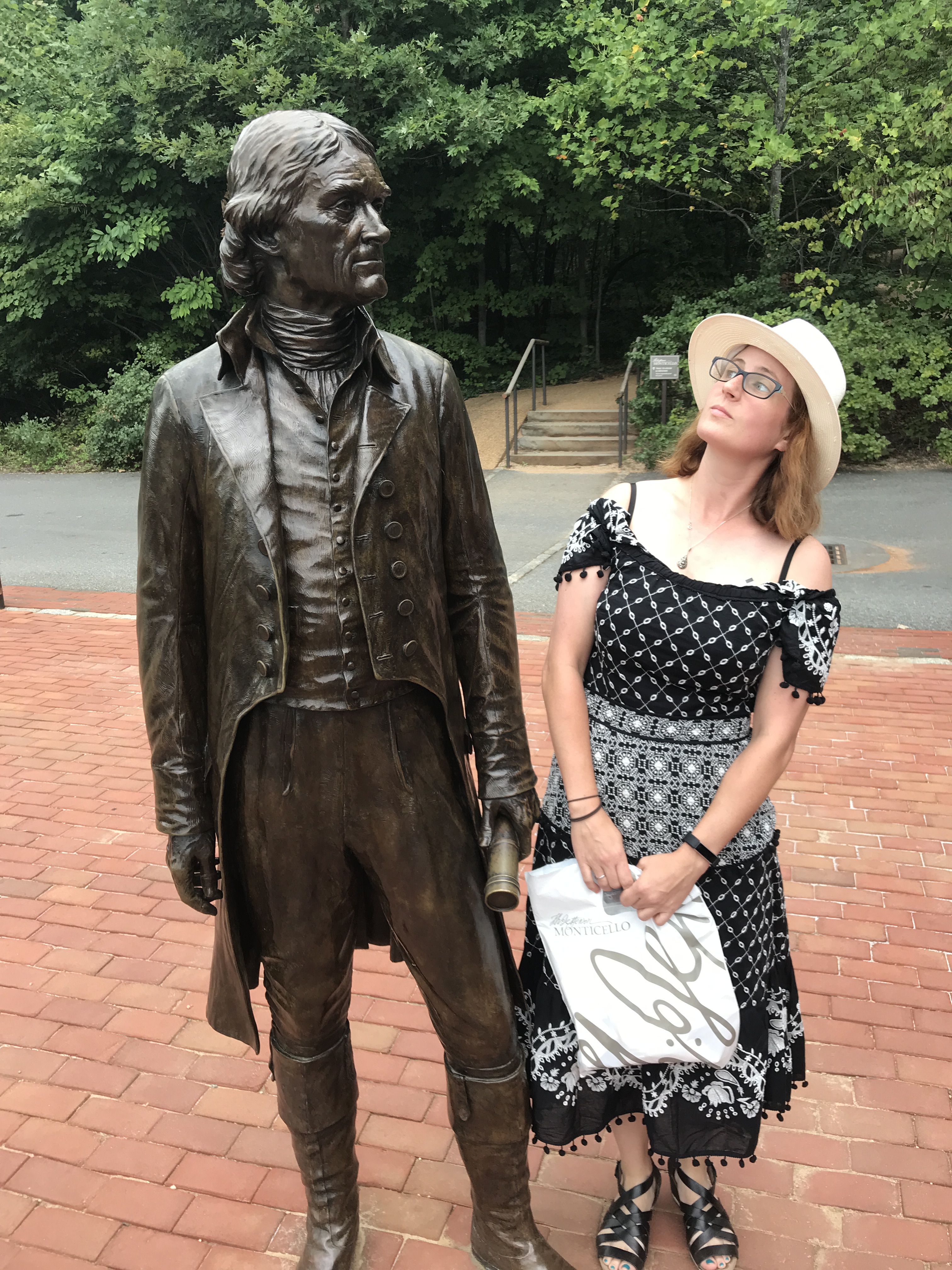
Abraham Lincoln was not a perfect man. Nor was Thomas Jefferson, nor Washington, nor any of the others who have volunteered to shoulder the yoke of leadership in this country or any other. I think we are inclined to look backward with our 20-20 hindsight, and smooth away any nuance, praising great achievements in times much simpler than our own, and seek to somehow ‘get back there.’ We have somehow devolved, how do we get back to the good old days? But no days were completely good, nor indeed completely bad. There are always contradictions, always differing viewpoints. What truly makes this, or any other country, great, is the fact that despite it all, we’ve somehow managed to continue to find a way forward together. Through thick and through thin. We didn’t allow ourselves to be permanently divided even in the face of the Civil War, we believed we could somehow make it through stronger as a Union. United. Despite our differences.
So why study history? And why choose to reflect on our distant past on our current election day? There are many reasons, but the two that stand out most forcefully to me are these:
To learn from the mistakes and the wisdom of those who have wrestled with life before us, often in circumstances much more dire and challenging than we can imagine.

And to remind ourselves, as we continue to strive, sometimes violently, for that ‘perfect’ candidate, the ‘perfect’ solution, the ‘perfect’ country, that none of those things do or have ever existed. All we can hope for is to do our best, and hopefully unite ourselves towards a common cause under the leadership of someone who is also doing their best, not just for themselves, but for the best compromised good for all the varied people that call this vast country, and this ongoing experiment home.
So dear ones, go out today and vote your conscience. I simply ask that as you do, you remember all of the people who have worked and bled and sacrificed in hope to get us here, and all of your fellow citizens who may not agree with you, but are, just like you, simply seeking their own life, liberty, and happiness.


3 thoughts on “Why Study History? An Election Day Reflection”